

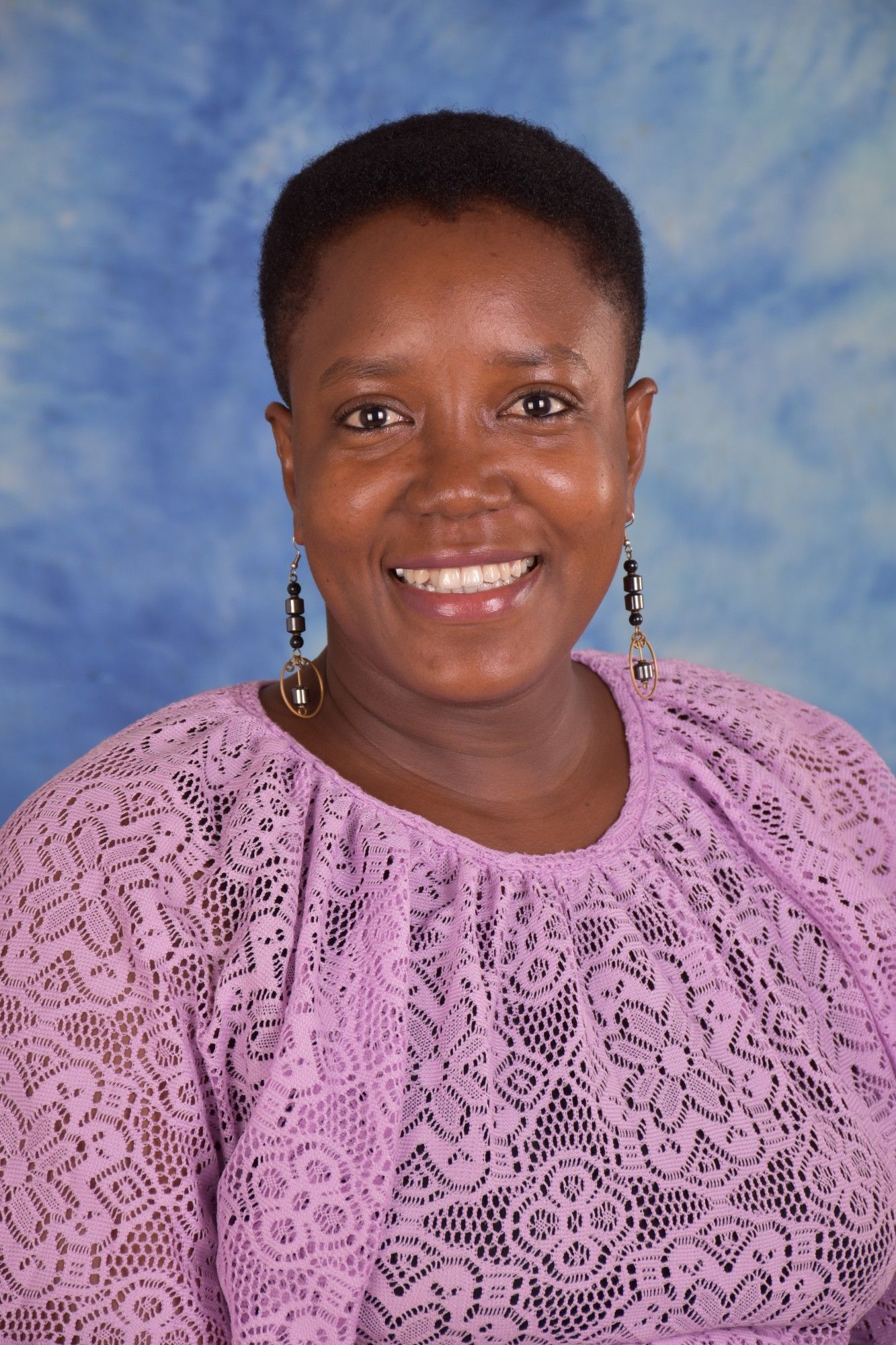
Courage, according to Caroline Dama, is listening to that voice inside that tells you who you are and where you’re meant to be, and choosing to follow it. Fearlessly.

“It’s like saying, ‘this is what sets my soul on fire’,” she explains. “And letting yourself burn. Not to destroy yourself, but to rise and be the glorious you that you are.”
Caroline tries to live that way, as a mother, a daughter, a sister, a friend and a leader.
“Giving my best to each of those roles takes courage,” she says. “Even when things don’t work out the way I hope, I still have to show up and keep going.”
This year has made that clearer than ever.
“Every morning, I’ve gone to the office wondering whether we’d have enough resources to keep our work going,” she admits. “But my team still needs me to lead. Our communities still need us to show up. Courage has meant knowing it will be hard and still saying, ‘Here I am.’”
***
The events leading up to Caroline’s hard, in this case, were set in motion on January 20th. It was the first day of President Donald Trump’s return to the White House. Within hours, he issued an executive order freezing US foreign assistance. The decision may have been political, but its impact was painfully human. In the community where Caroline works, the aftermath was almost immediate.
Pregnant women and young children who had relied on nutritional supplements from the funding were suddenly left without support. Farmers who had depended on similarly funded programmes to grow food were stuck.
As the Country Coordinator of Green World Campaign Kenya, a community-driven initiative that builds resilient food and water catchment systems in Kenya’s coastal arid and semi-arid lands, Caroline knew a solution had to come fast. And it had to come from within.
Her team started with the pregnant women.
“We asked ourselves: What can people sustain? What do we already have? And how do we anchor it in the systems that already exist?”
Working alongside community members, Green World Campaign Kenya set up African Indigenous vegetable nurseries at local health centres. When expectant mothers came for checkups, they also learned basic nutrition that relied on familiar, accessible and resilient vegetables.
“Sometimes,” Caroline reflects, “all you need is to create spaces where people can recognise and appreciate the resources they already have.”
***
Caroline’s story begins in a little-known indigenous community on the Kenyan coast: the Kauma. According to the most recent national census, their number is just over 71,000 people. To put that into perspective, that’s less than 0.2% of Kenya’s population.
In a community that small, and in a country where girls’ education is still undervalued in many places, Caroline’s path could have been very different. But her father was not like most men of his generation. He believed fiercely in the power of education, especially for girls. He made sure she went to school, all the way to university.
Whenever she returns home, Caroline feels the weight of that privilege. It is what drives her.
***
Her career began in the classroom as a high school language teacher. French and Swahili, to be exact.
“Most people think teenagers are chaotic,” she laughs. “But I loved teaching them. And because I love storybooks, I would have regular classes four days a week, and on the fifth day, we would read books. It was beautiful to see how this opened up their minds.”
Three years into her teaching career, an NGO approached her school with plans for a large-scale environmental program. This interested her because she believed then and still believes now that truly resilient systems must start with children.
“If you can help them really feel the earth again, almost return to something we lost as a generation, they grow up with a different kind of responsibility and care,” she says.
That conviction pulled her out of the classroom and into community work. Yet in many ways, her new path still feels a lot like teaching because her work continues to be centred on giving people the capacity to succeed.

Her mostly young Gen Z team, which she describes as brilliant and full of ideas, has surprised her in the best of ways. Contrary to what many might expect, Caroline discovered that they have a deep interest in indigenous knowledge. And when they blend that with their tech-savvy instincts, the results are remarkable.
***
Caroline and her team teach children to set up tree and vegetable nurseries, take part in reforestation, and connect with indigenous elders. And because schools belong to communities, parents join planting days, learn alongside their children, and share their own knowledge too. These same parents then receive agribusiness training and often become caretakers of the seedlings when schools close.
The goal is to create self-sustaining systems from a holistic lens because, as Caroline puts it, “every ecosystem affects another ecosystem, and every contribution matters”.
Her approach is to meet people exactly where they are. She explains:
“We work with farmers whose only concern is whether they can produce enough food for their children. And then there are young people who want to plant 10,000 trees. Some farmers eventually notice that the small woodlot around their land protects their soil and water. They then start nurseries or help the schools care for seedlings. Over time, everyone realises how deeply they depend on one another. This diversity is what we need more of. Different ecosystems supporting each other. Because when one fails, another carries the weight.”
She remembers a drought three years ago when vegetables wilted and farms dried up. It was the fishermen who kept the community alive by bringing in fish from the restored mangroves.
“That is what I call resilience,” she says.
And that is why donor dependency troubles her so deeply.
“There are a lot of flaws in how donor aid is done,” she says. “It’s built on the idea that resources must come from outside. So when donors leave, they take everything with them, including the manpower or what we call expatriates. And then, we are left to start over.”
For that matter, Caroline’s primary concern is local resource mobilisation: building systems that rely on local knowledge, local people and local resources. Money matters, yes, but it is not everything.
“As Africans, we never used to think everything had to be paid for,” she says. “If a mother couldn’t look after her child, someone else would step in. And in return, that mother would one day help plough her neighbour’s field. People looked out for each other. That’s a resource. Our communities are a resource. Our indigenous knowledge is a resource.”
Somewhere along the way, she reflects, people were taught to believe these local resources were less valuable and that money, or people with money, are what mattered.
“And that’s how dependency is created,” she says. “But I grew up watching my grandmother harvest indigenous seeds and store them in a granary. It was only when I got to school that I started being told the imported seeds were better. I remember extension officers encouraging farmers to buy exotic seeds like cabbage and spinach.”
It is when droughts strike that people see what, in reality, works and what doesn’t. The cabbages die. The indigenous vegetables stay strong. And suddenly, those affected begin to understand the power and necessity of truly resilient systems.
Caroline admits that the shift won’t happen overnight, but continues to guide others gently and patiently. At the same time, she is realistic about the complexity of the issues.
“In food-insecure communities, if an indigenous crop takes six months and the non-indigenous one takes three, you may need a hybrid system,” she explains. “Use what meets the immediate need, but also grow what sustains you long-term. What matters is that people make their choices from a point of knowledge, not pressure.”
***
Caroline has seen farmers protecting a small woodlot, children caring for seedlings, mothers growing food that withstands drought, elders passing down crucial survival knowledge, youth blending indigenous wisdom with technology, and fishermen restoring mangroves that feed whole villages. The list is endless and, to her, this is what courage looks like in motion: ordinary people offering what they have, right where they are.
“Sometimes you may feel like you should be doing something bigger or different,” she says. “But that is never the case. Start where you are. Recognise what you’re good at. Have the courage to step up and play your part. Do it really well. And it will ripple out into something bigger than you could ever have imagined.”


